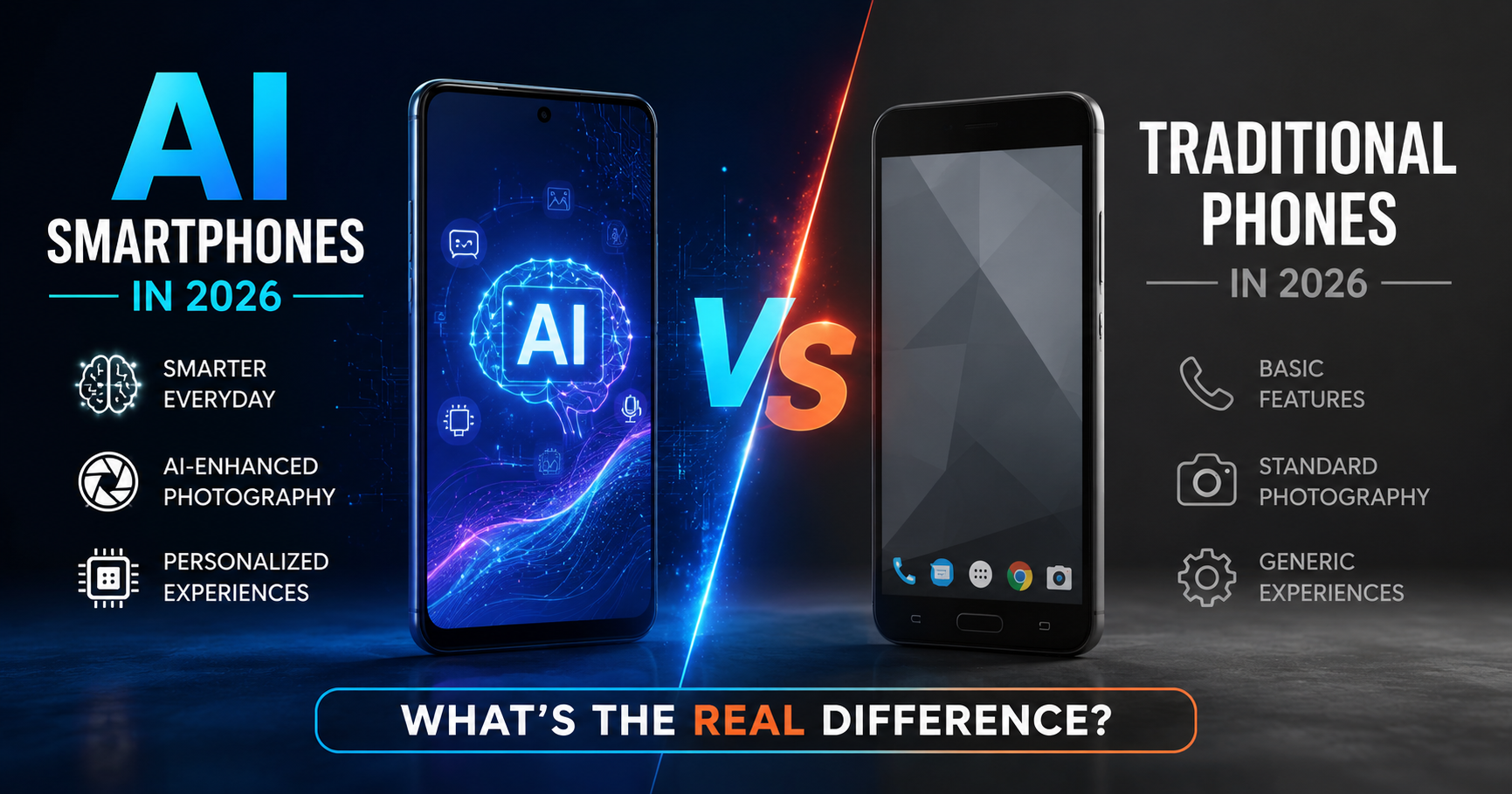
Smartphones in 2026 are smarter than ever before. Artificial Intelligence (AI) is now deeply integrated into modern mobile devices, changing how people:
- Take photos
- Edit videos
- Use apps
- Search information
- Communicate
- Manage battery life
- Improve productivity
As a result, a major debate has started in the smartphone industry:
Are AI smartphones actually better than traditional smartphones?
Brands like Google, Samsung, Apple, OnePlus, Xiaomi, and Vivo are aggressively promoting AI-powered features in their latest devices. From AI photo editing to live translation and smart assistants, AI smartphones are becoming the biggest trend in mobile technology.
But many users still wonder:
- Are AI phones really useful?
- Do they improve daily usage?
- Are traditional phones still enough?
- Is AI just marketing hype?
In this article, we compare AI smartphones vs traditional phones in 2026, including:
- Features
- Performance
- Cameras
- Battery optimization
- Privacy concerns
- Real-world benefits
- Buying recommendations
Let’s explore whether AI smartphones are truly the future.

What Is an AI Smartphone?
An AI smartphone uses artificial intelligence to improve the overall user experience.
AI in smartphones helps devices:
- Learn user behavior
- Optimize performance
- Improve photos
- Predict actions
- Automate tasks
- Enhance voice assistants
Unlike traditional phones, AI smartphones continuously adapt based on usage patterns.
What Are Traditional Smartphones?
Traditional smartphones focus mainly on:
- Hardware performance
- Manual controls
- Standard software features
These phones may still include basic smart features, but they do not heavily rely on advanced AI processing.
Traditional phones mainly depend on:
- Raw processor power
- Camera hardware
- User input
rather than intelligent automation.
Why AI Smartphones Became Popular
AI technology exploded in popularity after major improvements in:
- Machine learning
- Voice recognition
- Generative AI
- Cloud computing
- On-device AI chips
Smartphone companies realized AI could dramatically improve:
- Photography
- Productivity
- Search
- Battery efficiency
- Personalization
AI is now becoming one of the biggest smartphone selling points.
Key Differences Between AI Smartphones and Traditional Phones
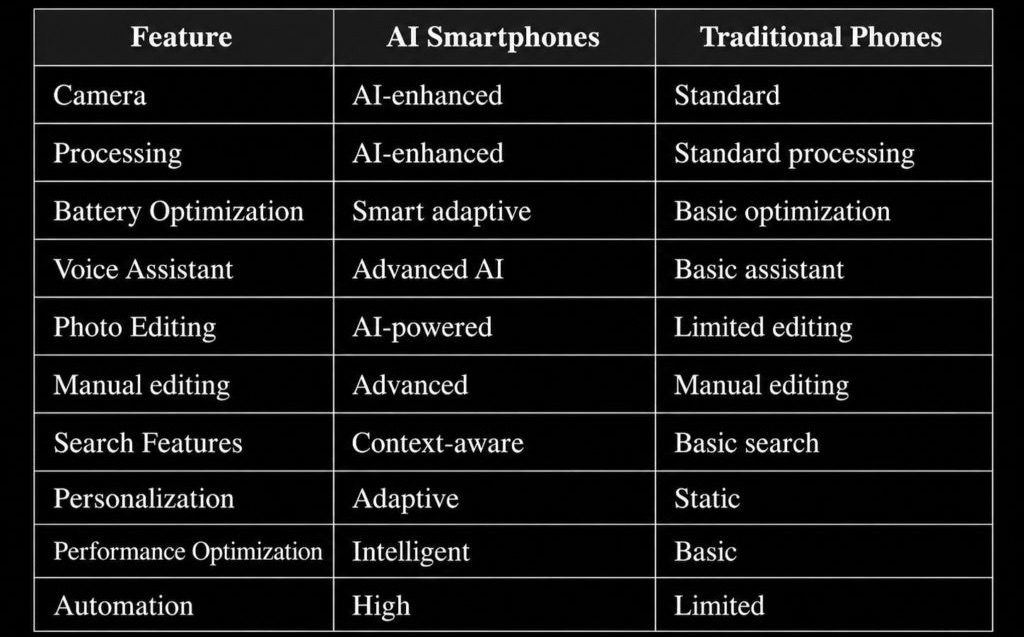
AI Camera vs Traditional Camera
AI Smartphone Cameras
AI smartphones use machine learning to improve photos automatically.
AI Camera Features
- Scene detection
- AI portrait enhancement
- Night photography optimization
- Smart HDR
- AI object removal
- Real-time beautification
AI helps users capture better photos without manual settings.
Best AI Camera Phones in 2026
- Google Pixel 10 Pro
- Samsung Galaxy S26 Ultra
- Vivo X200 Ultra
Traditional Smartphone Cameras
Traditional phones rely more heavily on:
- Sensor quality
- Hardware lenses
- Manual photography skills
Photos may require:
- More editing
- Better lighting
- Manual adjustments
Camera Winner
Winner: AI Smartphones
AI dramatically improves smartphone photography for everyday users.
Performance Optimization Comparison
AI Smartphones
AI helps phones:
- Manage RAM intelligently
- Optimize battery usage
- Predict frequently used apps
- Improve multitasking
The device learns user habits over time.
Example
If you regularly open:
- YouTube
the phone may preload those apps for faster launching.
Traditional Phones
Traditional smartphones depend mainly on:
- Processor speed
- RAM capacity
without intelligent behavioral learning.
Performance Winner
Winner: AI Smartphones
AI improves efficiency and responsiveness.
Battery Life Comparison
AI Smartphones
AI battery systems analyze usage patterns.
AI Battery Features
- Adaptive charging
- Smart power saving
- Background app optimization
- Usage prediction
Phones can intelligently reduce unnecessary battery drain.
Traditional Phones
Traditional phones mainly rely on:
- Battery size
- Basic optimization
without deep behavioral learning.
Battery Winner
Winner: AI Smartphones
AI improves battery efficiency significantly.
AI Features Changing Smartphones in 2026
Modern AI smartphones now include:
Popular AI Features
- Live translation
- AI call summaries
- AI writing assistance
- Smart image editing
- AI wallpapers
- AI transcription
- Circle to Search
- Voice cloning tools
AI smartphones are becoming digital assistants rather than simple communication devices.
Software Experience Comparison
AI Smartphones
AI-powered software feels:
- Smarter
- More personalized
- Faster
- More adaptive
Examples
- Smart notifications
- AI-generated replies
- Predictive search
- Personalized suggestions
Traditional Smartphones
Traditional phones offer:
- Standard interfaces
- Manual navigation
- Less personalization
Software Winner
Winner: AI Smartphones
AI creates a smarter and more convenient experience.
Gaming Comparison
AI Smartphones
AI helps optimize:
- Graphics settings
- Thermal management
- Frame rates
Some phones even use AI gaming assistants.
Traditional Phones
Gaming performance depends mainly on hardware power.
Gaming Winner
Winner: Tie
Gaming still relies heavily on processor and GPU strength.
Privacy Concerns with AI Smartphones
One major concern about AI phones is privacy.
Concerns Include
- Data collection
- AI monitoring
- Voice analysis
- Cloud processing
Some users worry AI systems may access too much personal information.
Are Traditional Phones More Private?
In some cases, yes.
Traditional phones:
- Use less behavioral tracking
- Have fewer AI cloud integrations
However, privacy also depends on the brand and software policies.
Privacy Winner
Winner: Traditional Phones
Traditional phones may feel safer for privacy-focused users.
Best AI Smartphones in 2026
Google Pixel 10 Pro
Best AI software features and smart photography.
Samsung Galaxy S26 Ultra
Excellent Galaxy AI productivity tools.
iPhone 17 Pro Max
Strong on-device AI and ecosystem integration.
OnePlus 15 Pro
AI-powered performance optimization and fast multitasking.
Are AI Smartphones Worth Buying?
AI Smartphones Are Worth It If You:
- Use cameras heavily
- Want smart automation
- Use productivity tools
- Like AI editing features
- Prefer personalized experiences
Traditional Phones Are Better If You:
- Prefer simplicity
- Care deeply about privacy
- Don’t use AI tools much
- Want basic smartphone usage
Biggest Advantages of AI Smartphones
AI Benefits Include
- Better photography
- Smarter battery management
- Faster search
- Easier editing
- Improved productivity
- Personalized experience
AI reduces manual work significantly.
Biggest Disadvantages of AI Smartphones
Potential Downsides
- Privacy concerns
- Heavier software
- Increased battery usage in some cases
- AI features may feel unnecessary for basic users
Some users also dislike excessive automation.
Future of AI Smartphones
Future AI smartphones may include:
- Real-time AI assistants
- AI-generated videos
- Advanced voice interaction
- Personalized operating systems
- Smarter cameras
- Fully AI-powered search
AI integration will likely become even deeper.
Common Myths About AI Smartphones
Myth 1: AI Phones Are Only Marketing
False.
AI genuinely improves:
- Photography
- Search
- Productivity
- Battery optimization
Myth 2: AI Replaces Hardware
False.
Good hardware still matters greatly.
AI enhances hardware rather than replacing it.
Myth 3: AI Phones Are Only for Tech Experts
False.
Most AI features work automatically for regular users.

Final Verdict
AI smartphones are clearly shaping the future of mobile technology in 2026. They provide smarter experiences through:
- Better photography
- Intelligent battery management
- AI editing tools
- Personalized software
- Advanced productivity features
For most users, AI smartphones offer clear advantages over traditional phones.
However, traditional smartphones still remain suitable for users who prefer:
- Simplicity
- Privacy
- Basic functionality
Overall, AI smartphones are becoming increasingly useful rather than just being a marketing trend.
As AI technology continues improving, future smartphones will likely become even smarter, faster, and more personalized.